
Mid-Term Review of Scaling Citywide Inclusive Sanitation Service Systems Underway in Kathmandu
Mid-Term Review
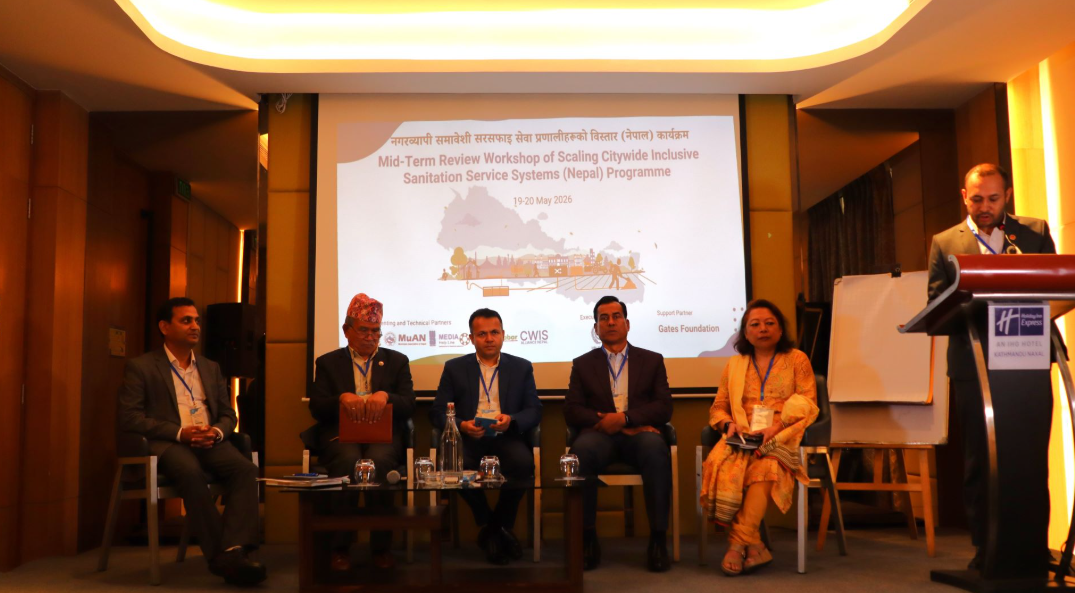
Kathmandu: A mid-term review of the “Scaling Citywide Inclusive Sanitation Service Systems (Nepal)” program is currently being held in Kathmandu.
The review program, which began on Tuesday, has brought together mayors, WASH focal persons, and representatives of concerned stakeholder agencies from seven municipalities across all seven provinces, along with three strategic municipalities participating in the program.
A Memorandum of Understanding (MoU) for the implementation of the program had been signed on Asar 13, 2082 between the respective municipalities and partner organizations. The MoU clearly outlined the roles and responsibilities of both the partner institutions and municipalities during program implementation.
During the mid-term review, municipality-wise presentations were delivered on the progress achieved so far, the status of fulfillment of responsibilities as per the agreement, challenges encountered during implementation, and the activities that still need to be carried out during the remaining project period.
According to the MoU, the Municipal Association of Nepal, in coordination with WaterAid Nepal, the Ministry of Water Supply, the Department of Water Supply and Sewerage Management, and UN-Habitat, was responsible for providing technical support to the municipalities. This included support in the formulation of fecal sludge management-related acts, regulations, procedures, plans, and policies; data collection and updating in the N-WASH system; capacity development trainings; and monitoring and evaluation activities.
Similarly, the participating municipalities had committed to endorsing fecal sludge management-related policies and plans within the project period, allocating at least 15 percent of the sanitation budget to fecal sludge management, providing the necessary land and infrastructure, and designating focal persons through the environment and sanitation section for project implementation.
Land Management Identified as the Biggest Challenge
During the review, most mayors stated that land management for solid waste and fecal sludge management has become the biggest challenge.
Mayor Narulal Chaudhary of Ghorahi Sub-Metropolitan City, Dang, said that acquiring land required for waste management has been extremely difficult. He mentioned that federal and forestry-related legal complexities have hindered waste management efforts and stressed the need for legal reforms that would allow local governments to utilize land with usufruct rights for such purposes.
Similarly, Mayor Krishna Bahadur Rana Magar of Gorkha Municipality stated that land management has become even more complicated than budget management. According to him, obtaining usufruct rights over the required land takes a long time, creating obstacles in advancing fecal sludge management activities.
Emphasis on Expanding Treatment Plant Capacity
Mayor Birendra Bhatt of Godawari Municipality informed that an integrated solid waste management center has already come into operation in the municipality. He stated that the center also includes a fecal sludge management facility, but its current capacity is insufficient compared to existing demand, making expansion necessary.
According to him, under the agreement, the construction company will operate the facility for two years after construction completion, and the facility is currently being run accordingly. Since the municipality will eventually have to operate the center on its own, eight staff members have already been mobilized for the purpose. He further noted that sludge is also being transported to the facility from neighboring municipalities, making capacity expansion unavoidable.
Likewise, Mayor Gopal Chandra Budhathoki of Mechinagar Municipality, Jhapa, stated that the municipality has been working with the goal of establishing itself as a model municipality for fecal sludge management in Nepal. He shared that two treatment plants have been in operation in the municipality for the past five to seven years and that the project is now moving forward toward more effective operation through the preparation of a business plan.
Focus on Sanitation Infrastructure and Environmental Campaigns
Mayor Chiri Babu Maharjan of Lalitpur Metropolitan City emphasized that the wastewater treatment plants under construction at Sundarighat and Balkumari should be completed as soon as possible. Expressing hope that the removal of informal settlements along the Bagmati Riverbanks would contribute to reducing river pollution, he urged that no structures other than sewerage infrastructure be constructed in the cleared areas.
He also informed that a European-standard public toilet has been constructed in the Patan area and that a modern public toilet facility with bathing services will soon come into operation.
Meanwhile, Mayor Prakash Bhandari of Sharada Municipality, Salyan, shared that seven public toilets are currently in operation within the municipality. He stated that the municipality is planning to distribute cloth bags bearing the municipality’s logo to discourage the use of plastic bags and has already initiated separate collection of biodegradable and non-biodegradable waste.
Following the presentations by the municipalities and remarks from the respective mayors, Sudha Shrestha, National Professional Officer (WASH) at UN-Habitat, stated that the program is moving strongly toward success. She informed that the review concluded with the preparation of action plans for activities that need to be carried out to make the remaining implementation period even more effective.
Municipalities Where the Program Is Being Implemented
- 1. Godawari Municipality, Kailali – Sudurpashchim Province
- 2. Sharada Municipality, Salyan – Karnali Province
- 3. Ghorahi Sub-Metropolitan City, Dang – Lumbini Province
- 4. Gorkha Municipality, Gorkha – Gandaki Province
- 5. Lalitpur Metropolitan City, Lalitpur – Bagmati Province
- 6. Lahan Municipality, Siraha – Madhesh Province
- 7. Mechinagar Municipality, Jhapa – Koshi Province
The “Scaling Citywide Inclusive Sanitation Service Systems (Nepal)” program is being implemented with financial support from the Gates Foundation, with UN-Habitat serving as the executing agency.
Partner organizations of the program include the Municipal Association of Nepal, WaterAid Nepal, the Ministry of Water Supply, the Department of Water Supply and Sewerage Management and National Water Supply and Sanitation Research, Innovation and Capacity Development Centre.